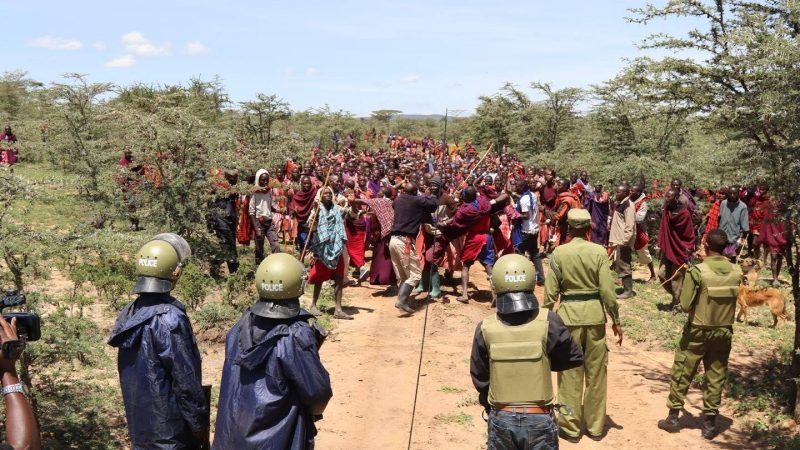
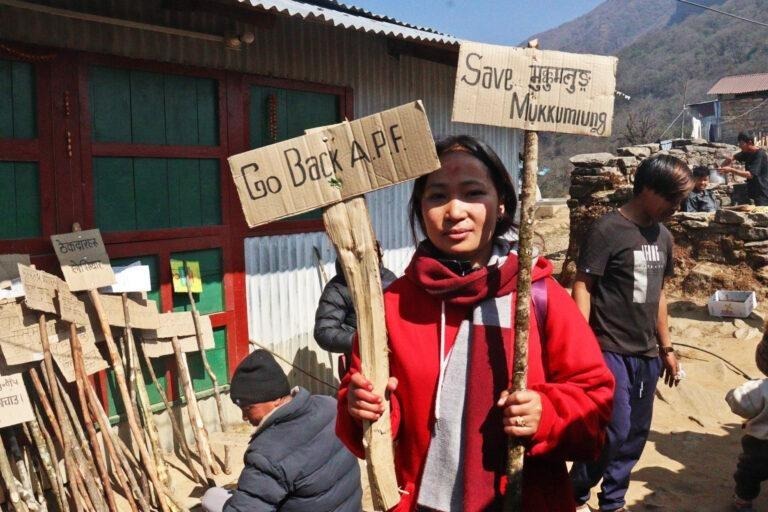
Indigenous communities in Eastern Nepal accuse the World Bank’s Linked Cable Car Project of rights violations.
By Witness Radio Team
A $22 million cable car project cutting through sacred forests in eastern Nepal has become the centre of a growing dispute. Indigenous communities accuse developers and the World Bank Group of enabling forced development that violates community land rights and exacerbates human rights abuses.
The project, whose construction began in 2022, is developed by Pathibhara Devi Darshan Cable Car Pvt. Ltd., a subsidiary of Nepal’s powerful IME Group, and is being built on Mukkumlung Mountain, also known as Pathibhara, in Taplejung District. While the government has promoted the project as a tourism and accessibility initiative, the Indigenous Yakthung (Limbu) communities say construction has proceeded without their consent and at a high cultural and environmental cost.
According to the project’s Initial Environmental Examination (IEE), the cable car infrastructure would occupy 6.22 hectares (15.36 acres) of community and government forest land.
Community leaders opposing the project say it threatens local livelihoods and social structures, including more than 700 local porters, nearly 30 locally run small businesses, and approximately 1,700 households that depend on pilgrimage-related income. They also warn of irreversible damage to cultural heritage sites.
The cable car intends to transport pilgrims to the Pathibhara Devi temple, one of Nepal’s most revered Hindu shrines, which is currently accessible only via a steep, high-altitude trek. Project developers argue the cable car will boost tourism, generate employment, and allow elderly and disabled devotees easier access.
For the Yakthung people, Mukkumlung is not merely a pilgrimage site but a sacred ancestral land that embodies their spirituality, culture, and identity.
“This mountain is sacred ancestral land. It defines our spirituality, culture, and customary law,” said Advocate Shankar Limbu, vice-chair of the Lawyers’ Association for Human Rights of Nepalese Indigenous Peoples (LAHURNIP). “Clearing forests and altering the mountain’s ecology weakens its spiritual power and violates our collective rights.”
Local leaders say they were never consulted before construction began, highlighting a clear violation of their rights and raising concerns over FPIC breaches.
“The IFC’s own Performance Standards state that Indigenous Peoples have the right to give Free, Prior and Informed Consent to projects on their lands,” said Saru Singak of the Mukkumlung Conservation Joint Struggle Committee. “But no one ever asked us whether we wanted this project. It is destroying forests and sacred landscapes and disrespecting our religion and culture.”
Environmental groups report that construction has already felled over 10,000 trees, including
protected species like Himalayan yew, threatening local biodiversity.
As forest clearing accelerated, opposition from local communities intensified. In January 2025, Nepal Police and Armed Police Force personnel reportedly used force against protesters, leading to the detention of dozens and sustaining severe injuries. Activists allege continued intimidation and retaliation against those opposing the project.
The dispute has drawn international attention, especially as the World Bank Group faces mounting scrutiny over financing harmful investments. Between August 2022 and July 2024, the IFC provided advisory services to the IME Group for four cable car projects in Nepal, including the Pathibhara project.
Indigenous leaders argue that during this period, the IFC failed to ensure compliance with its Environmental and Social Performance Standards, particularly regarding environmental assessments and the respect for communities’ right to Free, Prior, and Informed Consent, raising questions about its oversight and accountability.
In August 2025, Yakthung communities, supported by lawyers and civil society organisations, filed a formal complaint against the World Bank Group, alleging breaches of safeguarding standards that led to human rights abuses and the destruction of cultural heritage. In December 2025, the World Bank Group’s independent watchdog, the Compliance Advisor Ombudsman (CAO), formally registered the complaint and is currently assessing whether to proceed with mediation or a full compliance investigation.
For Indigenous rights advocates, the Pathibhara dispute reflects a broader pattern seen in World Bank–linked projects across Africa, Asia, and Latin America, where development initiatives proceed without meaningful community participation and accountability mechanisms are activated only after harm occurs, yet rarely provide a remedy.
A decade ago, an 11-month investigation by the International Consortium of Investigative Journalists (ICIJ), Evicted and Abandoned, found that an estimated 3.4 million people were physically or economically displaced by World Bank–funded projects, raising long-standing concerns over the institution’s ability to protect vulnerable communities.
IME Group operates across energy, manufacturing, infrastructure, and trade, and owns Global IME Bank, Nepal’s largest commercial bank. The IFC has provided more than $50 million to IME Group over the past decade.