


By the Witness Radio team.
For over ten years, families in Ranch 11, Kiryandongo District, cherished the hope that they had at last found a true home.
Their path to Ranch 11 was paved with hardship and repeated displacement. Some families, as Witness Radio discovered, were forced out of conservation areas, while others lost their homes amid political turmoil. When the government finally allocated them land through the Office of the President, they dared to believe their long search for safety was over.
Yet now, the very land they say President Yoweri Kaguta Museveni gave them has become the heart of a fresh conflict, as a sugarcane company lays claim to it.
Residents now accuse the Uganda Land Commission of quietly leasing part of Ranch 11 to sugarcane investor M/S Muhazi Heritage, leaving out the very communities who had built lives there for over a decade.
For families like Fred Kangume’s, this so-called development feels like yet another eviction, carried out without the voices or consent of those who call the land home.
“We were resettled on this land on orders of the President. And now we are surprised that an investor was given the same land without our consent or being informed,” Kangume told Witness Radio.
A Witness Radio investigation reveals a troubling contradiction: while official documents show attempts to secure land for these communities, the Uganda Land Commission later handed over more than 1,000 hectares of that very land to Muhazi Heritage through a lease agreement.
This dispute now sparks a deeper question about land governance in Uganda: how can families settled by government order lose their land when another state body gives it away to a private investor?
Several correspondences reviewed by Witness Radio indicate that President Yoweri Kaguta Museveni directed the Ministry of Lands to allocate land in Kiryandongo to approximately 750 landless families, including the Nubian and Kibyama communities who had converged in Kigumba and were living in difficult conditions in makeshift settlements.
The affected groups included about 350 families who had been evicted from the Karuma Wildlife Reserve in 1999 and 404 Nubian families who had been displaced from different parts of Uganda during and after the 1978/79 political turmoil.
According to information obtained by Witness Radio from the office of the Minister of State for Lands, the history of displacement for some of these families dates back to the 1970s.
During the government of former President Idi Amin, authorities established the Palestinian Farm at Kiroko in Kiryandongo Sub-county, displacing hundreds of families from their land.
The documents indicate that the affected families were neither compensated nor resettled after losing their land. As a result, some moved to neighboring public land, which was later gazetted as part of the Karuma Forest Reserve.
Years later, these same families faced another displacement when the Uganda Wildlife Authority evicted them from the reserve, leaving many without homes, land for cultivation, or reliable sources of livelihood.
The second group comprised members of the Nubian community who, after returning from exile, found that their former homes and properties in places such as Gulu, Lira, Soroti, and other parts of Uganda had been taken over during insurgencies. They also faced a challenging social and political environment, forcing many to seek refuge among friends and relatives in Masindi District.
With both groups facing prolonged landlessness and uncertainty, they petitioned President Museveni in 2000, requesting government intervention and resettlement.
A 2001 correspondence from the Ministry of Lands to the Office of the President states that government officials identified Ranch 11, part of the former Bunyoro Ranching Scheme, as available land that could be used to resettle the landless families.
The document states: “Within Masindi District, currently Kiryandongo District, was a vacant Ranch No. 11… which according to the Ranches Restructuring exercise was allocated to the Office of the President and could in this circumstance be subdivided to settle the landless 750 families.”
In 2006, President Museveni directed that the communities be resettled on approximately 5.5 square miles of land in Ranch 11.
For these families, the directive represented a new beginning and what they hoped would be an end to decades of displacement. In 2013, with support from local leaders and officers from the Ministry of Lands, the affected communities were resettled on the land.
Over the years, residents had built homes, established trading centers, and invested in agriculture. But according to residents, the land was never fully surveyed, and individual ownership documents were never issued.
In 2023, the Chief Administrative Officer (CAO) of Kiryandongo District requested financial support from the Ministry of Finance to facilitate the resettlement process for these categories: “Nubian community and families displaced from Karuma Wildlife Reserve.”
A letter from Permanent Secretary Ramathan Ggoobi informed the district that Shs200 million (about $53,428 USD) would be provided for the exercise. The funds, according to the letter, were to be budgeted under the Transitional Development Grant for the 2023/24 financial year.
Yet as communities waited in hope for official land documents, a separate process was quietly granting the same land to an investor.
Documents obtained by Witness Radio show that the Uganda Land Commission, during the Commission’s meeting of 4 August 2023 under Minute 64/2023(a)(04), approved the allocation of 1,059.89 hectares of land, equivalent to four square miles, to Muhazi Heritage.
The company received a five-year lease, renewable up to 49 years. On 17 December 2024, the Uganda Land Commission issued a certificate of title to Muhazi Heritage.
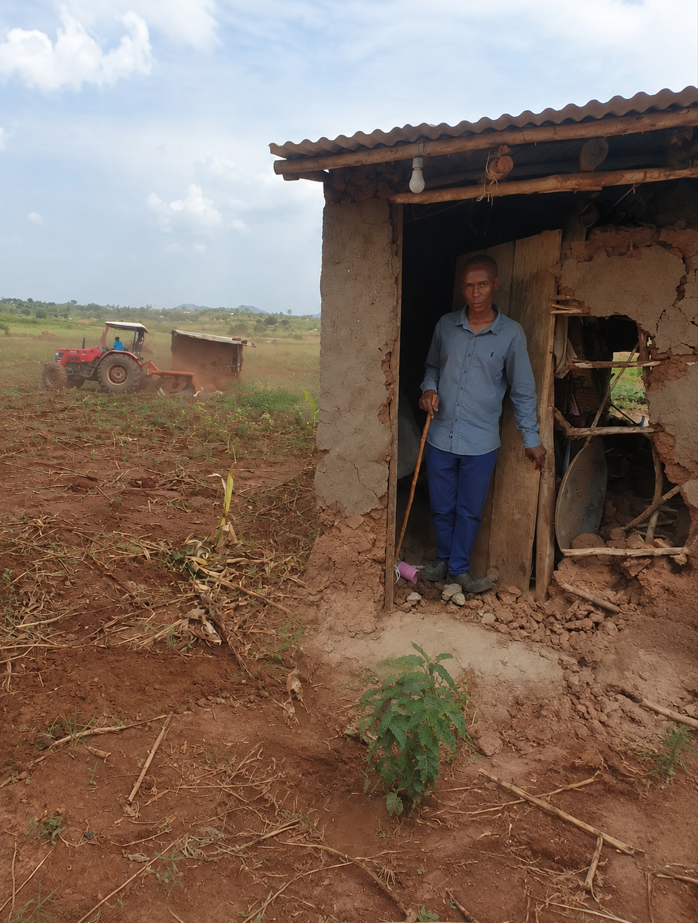
This turn of events stunned residents, who insist they were never consulted despite being the rightful occupants. Instead of security, the allocation sparked another wave of violent evictions as the company pressed for full control and communities fought back against what they called blatant land grabbing.
Charles Kalakire, the chairperson of Kimogola B village, told Witness Radio that local leaders were not involved in the allocation process.
“I was never consulted when the Uganda Land Commission awarded land to the company, which had legally known sitting tenants,” Kalakire said.
He added that he only learned about changes in land allocation after receiving information from district security officials.
“I got this information from the Resident District Commissioner (RDC), a president’s representative in the district, and the District Internal Security Officer (DISO) that land had now moved from the hands of the people to the investor,” he added.
Residents say the investor’s deal left just 1.5 square miles for over 750 families. For many, the conflict has spilled from paperwork into daily life.
“The situation is worse; people are beaten and forced to receive compensation, a level of impunity which forced the state minister of lands, Hon Sam Mayanja, to intervene and cause harmony in the area.” Mr. David Bakundaki, another resident, said.
During his visit to Kimogora in 2024, Mayanja revealed that the investor had requested the commission to allocate his company the entire Ranch 11 measuring over 5.5 square miles.
Based on his guidance, through a 2024 letter to the commission, he ordered the commission to allocate 4 square miles, and the remaining 1.5 square miles be used to resettle the affected people. The company was also directed to compensate residents, support relocation, and provide infrastructure including schools, health facilities, and roads as part of corporate social responsibility.
However, residents and leaders say the remaining land is already occupied, making relocation difficult.
“The people who have been occupying the four-square miles are now being packed into the 1.5 square miles. They are being allocated a quarter acre. On top of that, the allocations are now creating land tensions with those they found in.”
“Also, those who have received compensation have got peanuts, 200,000, 300,000 Uganda shillings, which can’t afford to cater for their families or buy land elsewhere, and the responsibility that had to come along with resettling people was never fulfilled.” Mr. Godfrey Kiviri, former chairperson of Mutunda A village, told Witness Radio.
Meanwhile, those refusing to leave their land face violence from company workers, supported by security forces.
The Ranch 11 saga lays bare a deep contradiction in Uganda’s land management: a government meant to restore dignity to the displaced later hands their land to a private sugarcane investor.
For these communities, the fight has become about more than land. It is now a struggle for trust, accountability, and the hope that government promises to its most vulnerable will be honored.