Wars are disrupting food systems, and ending world hunger requires urgent global action, experts say.
By the Witness Radio team.
Conflicts far from the world’s farms are reshaping how food is produced, traded, and accessed. Rising energy costs, fertilizer disruptions, and threatened trade routes expose the fragility of global food systems, increasing production costs and leaving millions vulnerable to hunger.
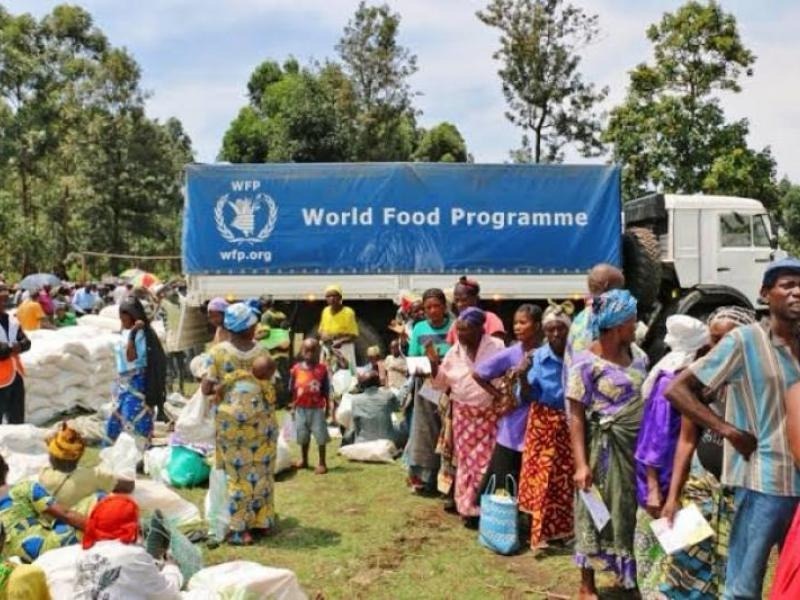
The global food crisis is deepening as multiple shocks put increasing pressure on food systems worldwide. According to the World Food Program (WFP), hundreds of millions of people face crisis-level hunger, with conflict, climate change, economic instability, and displacement driving food insecurity. Countries already struggling with poverty and fragile economies remain the hardest hit.
More than 295 million people across 53 countries and territories faced acute hunger in 2024, according to the Global Report on Food Crises. This was an increase of nearly 14 million compared with 2023, driven mainly by conflict, economic shocks, climate extremes, and displacement.
The war in Ukraine showed how conflict in one region can disrupt food supplies worldwide. Ukraine is one of the world’s leading exporters of wheat, maize, and sunflower oil, while Russia remains a major supplier of fertilizers and agricultural inputs. Disruption of Black Sea trade routes and uncertainty over exports triggered sharp increases in food and fertilizer prices, affecting farmers and consumers thousands of kilometers away.
Although global grain markets have gradually stabilized since the initial shock, experts say the structural vulnerabilities exposed by war remain unresolved. Many countries still rely heavily on a handful of exporters for staple foods and farm inputs, leaving them exposed whenever geopolitical tensions escalate.
Similar concerns are emerging from the Middle East. Disruptions surrounding the Strait of Hormuz, one of the world’s busiest shipping corridors, have raised fears over global supplies of oil, natural gas, and fertilizers. Because modern agriculture depends heavily on fuel and fertilizer, a prolonged interruption in these supplies has immediate consequences for food production.
During a ministerial meeting of the MED 9++ countries on “Supporting Food Security and Access to Fertilizers”, United Nations Director-General of the Food and Agriculture Organization (FAO) Q.U. Dongyu warned that the current crisis extends far beyond geopolitics, affecting food production, trade, agricultural inputs, and access to food worldwide.
“This is not only a geopolitical crisis, but also a disruption at the core of the global agrifood system,” he said.
He explained that agriculture follows fixed seasonal calendars and that fertilizers must be applied at precise stages of crop development.
“Agriculture operates on a crop calendar that cannot be postponed. Fertilizers must be applied at specific moments in the crop cycle. If they do not arrive on time, yields are reduced, regardless of what happens later.” He added.
According to QU Dongyu, even delays of a few weeks could reduce harvests, tighten food supplies through 2026 and 2027, and raise food prices worldwide, particularly in import-dependent countries across Africa and Asia.
Agricultural economist Dr. Joseph Glauber, a senior research fellow at the International Food Policy Research Institute (IFPRI) and former Chief Economist at the United States Department of Agriculture (USDA), says today’s food crisis is increasingly driven by rising production costs rather than shortages alone.
In an interview with Witness Radio, Dr. Glauber said energy prices are now one of the biggest factors pushing up food costs.
“The biggest link has been through energy. Higher energy prices mean higher shipping, transport, and processing costs. Consumers don’t eat wheat; they eat bread and processed foods that require energy throughout the production chain,” he added.
Dr. Glauber noted that while global prices for crops such as wheat and maize have risen only modestly, fertilizer and energy costs have risen much faster, leaving many farmers with shrinking profit margins.
“For farmers, profits have declined because input costs have risen faster than the prices they receive for their produce,” he said.
According to Dr. Glauber, African countries face unique challenges because they depend heavily on imported fertilizers and face higher transport costs than larger importing economies.
“Africa is quite vulnerable because shipment sizes tend to be smaller and transport costs are relatively higher,” he explained.
He noted that although fertilizer use varies significantly between African countries, higher prices are already putting enormous pressure on farmers across the continent.
Beyond these immediate impacts of war, experts say the world faces a broader systemic crisis. The Club of Rome has also warned that shocks from the COVID-19 pandemic and the war in Ukraine, to disruptions around the Strait of Hormuz and increasing geopolitical instability, have exposed profound weaknesses in global food systems.
The organization says food security can no longer be viewed apart from peace, climate resilience, and energy security. Governments should instead pursue integrated approaches that strengthen local food production and reduce dependence on vulnerable international supply chains.
Experts are calling for an end to armed conflicts that threaten food production, investment in regenerative agriculture, stronger land rights for smallholder farmers, diversification of food crops beyond the world’s heavy dependence on wheat, maize, rice, and soybeans, expanded regional trade, and a faster transition away from fossil fuel-dependent agriculture.
Hunter Lovins, President of Natural Capitalism Solutions and a member of the Club of Rome, says the world already knows many needed solutions.
“This is not a warning about some distant future. It is a warning about next year’s harvest. We know what works. What we lack is not solutions, but the political will to invest in them before the crisis, rather than after,” she said.